Guided Hiking
 Follow
You can hike the Drakensberg, South Africa’s highest mountain!
Hike mountains of over 3000m in safety and with an expert guide. A rare wilderness that will change your idea of mountain walking. Tailor-made hikes for discerning clients.
You can hike the Mafadi, SA’s highest peak or the Mini Traverse, Monte-aux-Sources, Cathedral Peak and much more.
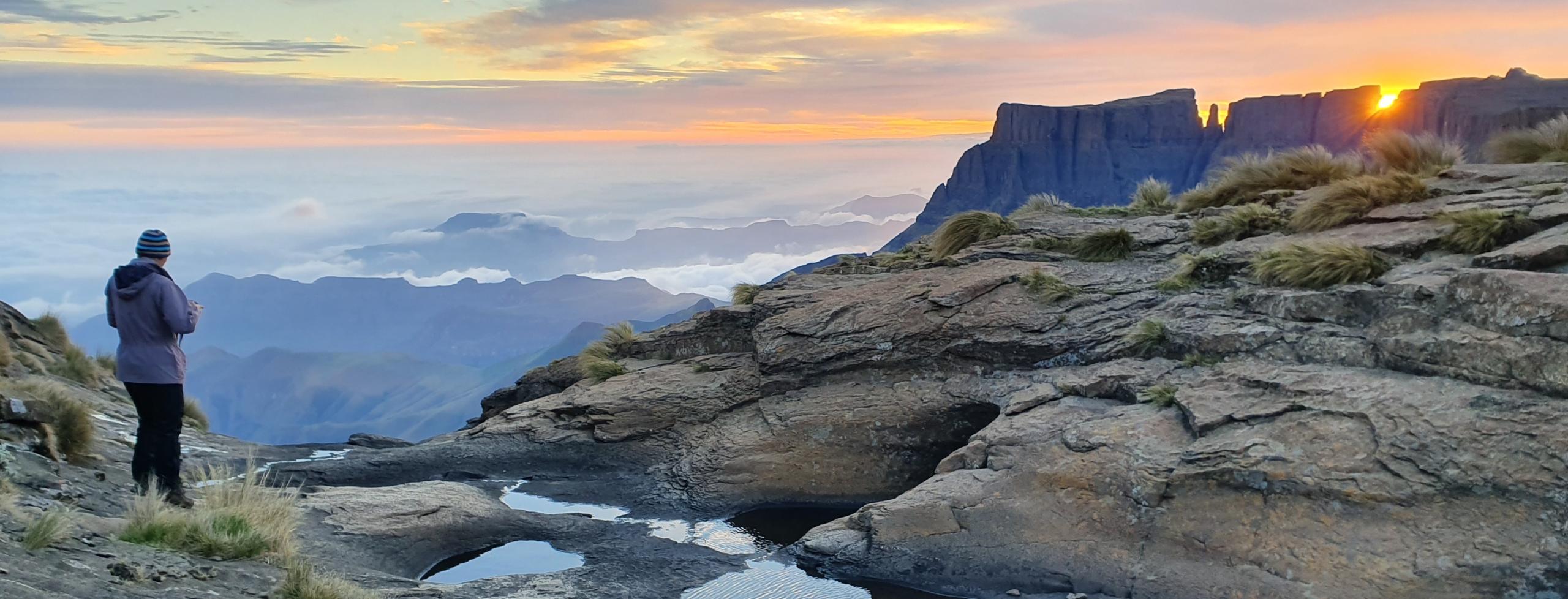
Drakensberg sunrise over Monte-aux-Sources
Guided Hiking
Hiking adventures are usually 2-5 days in length and involve camping in remote places. Hikers need to be fit and able to carry their own backpacks. Porters are available on request. The Drakensberg is a World Heritage Site, preserved for it’s mountain splendour and diversity of fauna , flora and African culture.
Hike the highest peak in South Africa – Mafadi 3451m.
You will find this a challenging trip over 3-4 days, camping in tents and caves in a remote setting. The hike starts and ends at Injasuthi in the central Drakensberg. You will need to be fit and able to hike long distances over rough terrain. The summit lies on the border of South Africa and Lesotho.
Mnweni Circuit
A 3 day hike that includes the ascent of a major pass and traverses the source of South Africa’s longest river.
Champagne Castle 3377m
A 3 day out and back hike deep in the Drakensberg wilderness. The summit day is done with day-packs from base camp. Accommodation in tents.
Amphitheatre and Mont-aux-Sources peak
Relatively easy hiking to the top of a South African icon. See the world famous Tugela Falls (second highest waterfall in the world). You will also stand on the edge of Amphitheatre and ascend the final cliffs via the chain-ladders.
Devil’s Knuckles Hike
A gentle hike in the southern Drakensberg over 3 days and 2 nights. Summiting the Devils Knuckles is optional. A very remote and seldom visited landscape.
Cleft Peak to Cathedral Peak Trek
If you only have 3 days and want to see the Drakensberg at its most spectacular, this is your hike. You will summit Cleft Peak and Cathedral Peak. Day 3 includes the Bell- Twins traverse. Spectacular and at high altitude!
Mini Traverse
A 5 day, 4 night long distance hike, that is described in several coffee-table books, as one of the world’s great treks. It is strenuous walking along the Lesotho/ Drakensberg plateau. You will camp in tents and sometimes in caves and see Lesotho tribesmen, vultures, wild antelope, baboons, the Tugela Falls and a sea of cloud below your feet.
Rhino Peak hike
If peak bagging is what appeals to you, this is a great one to have under your belt. Very spectacular hiking. 1.5 days trip with overnight camping.
Scramble Cathedral Peak 3005m
You will love this outing that involves hard hiking to foot of the peak, followed by some easy, yet specular scrambling to the top. Great views of Monks’ Cowl, Mafadi and Champagne Castle. The guide uses a rope for safety of clients.
The Grand Traverse
The longest and most challenging hike offered in South Africa – 14 days and 220kms at high altitude. It is only for the fittest hikers who have spent time on other long distance treks. To many, this is the ultimate hiking challenge.
This trek is from the Free State border at Mont-aux-Sources in the North, to the Eastern Cape border in the south at Bushman’s Nek. It is a trek, which traverses the entire Natal Drakensberg. Some of the features along the way include ascending the famous chain-ladders and also standing on the lip of the Tugela Falls. We hike past Cathedral Peak, Monk’s Cowl and Mafadi, the highest point in South Africa. You also summit the highest point south of Kilimanjaro.
Two food drops are made along the route by Peak High staff and two nights before the end we stay in comfortable accommodation at Sani Pass. Ask for a quotation.
Thanbana Ntlenyana 3482m
2 days at high altitude, but easy hiking.
This is southern Africa’s highest point, south of Kilimanjaro at a height of 3482m. It is a small and insignificant peak within the borders of Lesotho. The hiking is relatively easy and we spend one night in tents in the Lesotho Highlands. The hike starts from the top of Sani Pass.
-

- Giant’s Castle north face
-
- Cathedral Peak
-
- Amphitheatre
Gavin Raubenheimer
 Gavin is the owner & operator of Peak High Mountaineering. He is a certified Mountaineering Instructor (M.I.A.) endorsed by the Mountain Development Trust of SA. He is a NQF National Mountaineering (level 7), Cultural and Nature Guide (level 4). Gavin is a past President of the KwaZulu-Natal Section of the Mountain Club of SA. He has been involved in mountain rescue since 1992 and since 2005 has been the Convener of Mountain Rescue in the province. Want Gavin and his team at Peak High to guide you on a hike? Put yourself in the hands of the certified and experienced experts in mountain hiking, guiding and climbing.
See Gavin's Google + profile
Gavin is the owner & operator of Peak High Mountaineering. He is a certified Mountaineering Instructor (M.I.A.) endorsed by the Mountain Development Trust of SA. He is a NQF National Mountaineering (level 7), Cultural and Nature Guide (level 4). Gavin is a past President of the KwaZulu-Natal Section of the Mountain Club of SA. He has been involved in mountain rescue since 1992 and since 2005 has been the Convener of Mountain Rescue in the province. Want Gavin and his team at Peak High to guide you on a hike? Put yourself in the hands of the certified and experienced experts in mountain hiking, guiding and climbing.
See Gavin's Google + profile